Understanding PLC Programming: Languages, Architecture, and Best Practices
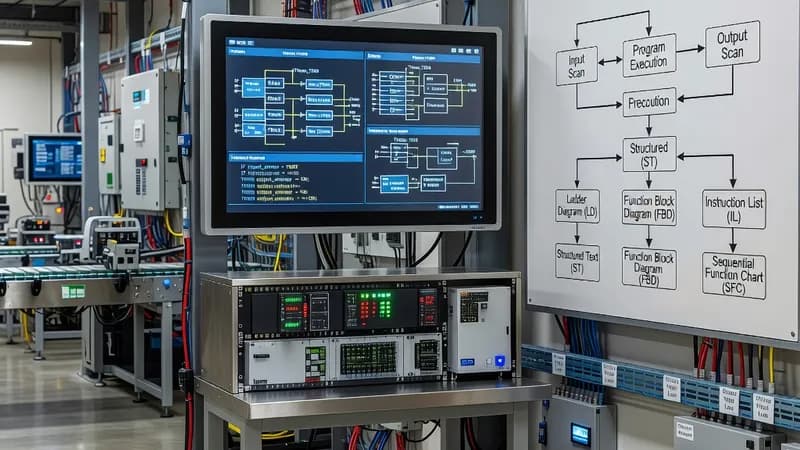
Programmable Logic Controller (PLC) programming is fundamentally standardized by the IEC 61131 suite, which ensures interoperability and consistency across industrial automation systems. The heart of this standard, IEC 61131-3, defines five core programming languages—Ladder Diagram (LD), Function Block Diagram (FBD), Structured Text (ST), Instruction List (IL), and Sequential Function Chart (SFC). This diversity of languages accommodates various engineering preferences and application needs, from graphical approaches like LD and FBD, favored for relay logic replacement, to textual languages such as ST, which supports complex arithmetic and control algorithms. By specifying common syntax, data types such as BOOL, INT, and REAL, and program organization units (POUs), IEC 61131-3 facilitates modular, reusable code modules that reduce development time and minimize human errors. First published in 1993 and last updated in 2013, this standard remains central to vendor-independent PLC programming.
Beyond programming languages, IEC 61131 addresses hardware and environmental requirements critical to industrial reliability. IEC 61131-2, now in its 4th edition (2017), defines essential equipment specifications including rated voltage levels—commonly 24 V DC nominal—and electromagnetic compatibility (EMC) tests requiring immunity to transient surges up to 2 kV. These thorough requirements ensure PLCs operate reliably under harsh electrical conditions typical in industrial environments. Additionally, integration with network standards like IEEE 802.3 supports Ethernet/IP communications up to 1 Gbps. Compliance with installation standards such as NEC Article 409 is also vital, mandating features like overcurrent protection at 125% of rated current and sufficient wire bending space (twice the conductor diameter) within control panels to maintain safety and serviceability.
In practice, selecting the appropriate IEC 61131-3 language depends on the application complexity and engineer expertise. Ladder Diagram excels in discrete control and is widely understood, while Structured Text enables sophisticated process control algorithms through constructs like REPEAT...UNTIL loops and advanced math functions (e.g., SQRT(), SIN()). Employing the modular POUs encourages code reuse and easier debugging, adhering to best practices recommended in the standard. Integrating standardized programming with compliant hardware specifications and robust network protocols results in scalable, maintainable industrial control systems that meet rigorous safety, performance, and interoperability benchmarks.